
Around the suburb
Mixed residential and employment land near the Nepean corridor
Penrith's urban and industrial studies describe Jamisontown as more than a residential suburb: homes sit beside light industry, large-format retail and the Mulgoa Road corridor, with Surveyors Creek and the Nepean River landscape nearby. Tench Reserve is a major public river access point. A backyard, showroom and riverside path each require a different safe approach.
VERIFIED LOCAL DETAIL
Why Jamisontown needs its own field note
Jamisontown has a genuine mixed-use character
Penrith's urban study records residential areas alongside light industry and bulky-goods uses, bounded by major roads and the Nepean side of the city. State the property type so the right entrance can be planned.
Penrith City Council — Penrith Urban Study ↗Surveyors Creek crosses the wider neighbourhood
Council planning identifies Surveyors Creek within the Jamisontown and South Penrith urban setting. Creek and drainage corridors should be reported from the nearest safe street or maintained path.
Penrith City Council — Penrith Urban Study ↗Tench Reserve is a principal Nepean River access point
Council's interactive river map identifies facilities and access around Tench Reserve. Use the exact car park, path or recreation feature and remain out of riverbank vegetation.
Penrith City Council — Nepean River interactive map ↗PET EMERGENCY CONTACTS
Jamisontown vet plan: local and after-hours
Save the local clinic and 24-hour hospital as separate contacts. That avoids searching from scratch if a dog or cat becomes weak, unsteady, collapses or was seen near an unknown snake.
Habitat clues, not a diagnosis Jamisontown
River and creek margins may suit red-bellied black snakes, open disturbed land may suit eastern brown snakes and sunny gardens or commercial edges may suit yellow-faced whip snakes. These are Penrith-area habitat examples only.
Eastern brown snake
May use open ground, grass margins, disturbed land and places where rodents are active.
Do not use this as an ID: Colour varies widely; a brown or grey snake cannot be identified safely by colour.
Australian Museum species guide ↗Red-bellied black snake
Often associated with wetter habitat such as creeks, drains, wetlands and dam margins.
Do not use this as an ID: The red or pink flank may be hidden from view, especially from above.
Australian Museum species guide ↗Diamond python
Can use mature trees, roof spaces, thick gardens, rockwork and sheltered structures.
Do not use this as an ID: Do not approach because a pattern appears familiar; large pythons can still defend themselves.
Australian Museum species guide ↗These are habitat-based possibilities for the wider district, not a claim that any species is common on a particular Jamisontown property. The Sydney snake identification guide explains the limits of visual identification.
LOCAL VISUAL / REGIONAL CONTEXT
The setting in context
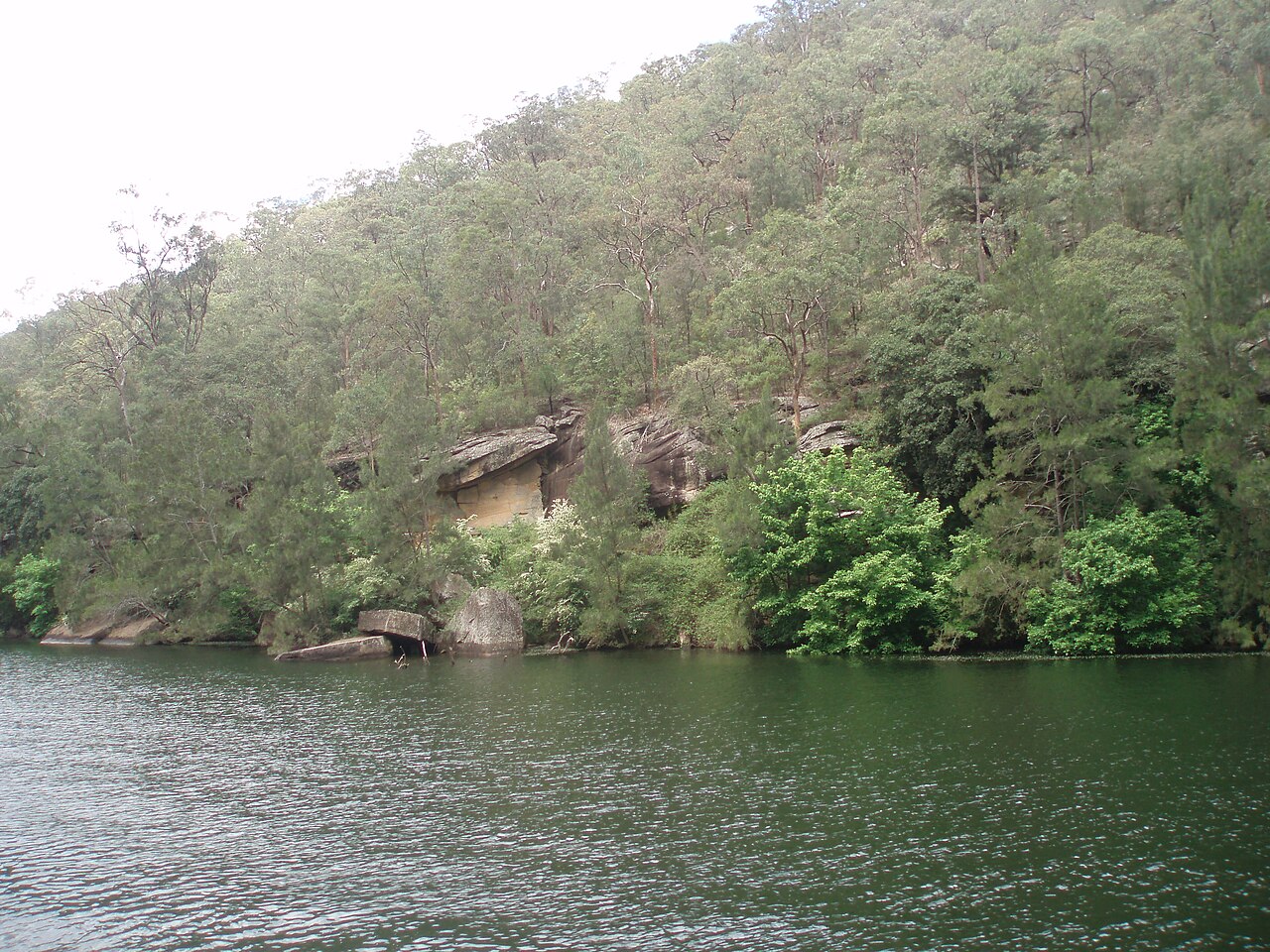
Nepean River at Penrith — a regional reference for river, reserve and foothill habitat.
Photo: sv1ambo / Wikimedia Commons ↗ · CC BY 2.0 ↗. Cropped for display.
Jamisontown map: use this to check the wider road, reserve and waterway pattern—not to approach a snake. Provider attribution appears inside the map.
a snake in a yard, garage, pool enclosure or under-house area
movement near Surveyors Creek, Jamison Park or a drainage boundary
a retail, workshop or warehouse sighting where customers and vehicles must be kept away
Keep the scene quiet
At home, observe through glass or from a protected doorway. At a business, close the immediate aisle, yard or bay and appoint one contact. Do not enter creek vegetation, move stock or follow a snake along the riverbank.
Do not touch, trap, corner or try to kill the snake. Bring children and pets away and call a trained reptile handler.
Finding the property
Give the street, business or reserve entrance and distinguish the residential, retail, industrial or river-side setting. Name the nearest gate, bay, path or fixed park feature and keep the approach outside the exclusion area.
Let us know whether the snake is inside or outside, whether a gate or door is locked and whether animals are still on the property.
Reducing easy hiding places
Seal doors, garage and roller-door gaps, manage rodents around bins and stock, and keep used paths visible. Maintain private drainage edges while leaving public creek and river vegetation undisturbed.
No property can be completely snake-proof. The practical aim is better visibility, fewer hiding places and less food for rodents, without harming native wildlife.
PET SAFETY / DETAILS CHECKED 28 AUGUST 2026
Vet reference from the suburb centre
Penrith Veterinary Hospital provides the local point of reference on this page. For an out-of-hours or immediately critical case, the wider-area emergency listing is ARH Greater Western Sydney. Call either hospital before transport when you can do so safely.
Open seven days; phone before travelling.
The hospital states that its emergency service is open 24 hours, every day.
The local listing is measured from the suburb centre only. It may not be the closest open service to every Jamisontown street, and the emergency hospital may advise a different destination after triage.
Independent contact information only. Snake Catcher Sydney Wide is not affiliated with these veterinary providers. In a life-threatening pet emergency, follow the veterinary team's instructions immediately.
The details worth having ready
We will ask where the snake was last seen, what sort of property it is and the safest place to meet you. An existing photo can be useful, but nobody should move closer to take one. Once we know the situation, we can give you an honest indication of availability and travel time.
Call 000 immediately. Keep the person still and calm, apply a pressure immobilisation bandage, and do not wash, cut or suck the bite. Follow the emergency operator and Healthdirect guidance ↗.
A few things to know
Answers for Jamisontown
What should I report for a snake near Tench Reserve?
Give the correct river-side entrance and nearest car park, path, picnic area or other fixed feature. Stay on formed access, keep other visitors away and do not enter the riverbank vegetation.
Do I need pest control or a snake catcher?
If you are searching for pest control or pest removal because you have found a snake, contact a licensed snake catcher directly. A pest-control business that does not provide licensed snake handling may need to refer your call, adding a step and potentially delaying arrangements. Some pest controllers also offer licensed snake catching; ask whether they can arrange an appropriately licensed handler. Keep people and pets away and call Snake Catcher Sydney Wide to confirm the fee, availability and estimated arrival.
What if I lose sight of the snake in Jamisontown?
Do not pull things apart to find it. Remember the last position and direction of travel, keep the area quiet and explain what happened when you call.
What should I do with dogs or cats?
Move pets indoors or into another secure area without going near the snake. Do not let a pet investigate the last sighting point.
The local background comes from Penrith City Council — Penrith industrial precincts ↗, with snake safety checked against NSW Environment guidance ↗. The embedded public map is used to confirm the suburb, roads and named landscape reference. Habitat can vary from street to street, so we do not claim that a particular species is common at any address.