
Before anyone gets too close
The river side and the hill side need different directions
Leonay is compact, but its blocks are not all approached the same way. River Road and the lower river reserve feel very different from homes climbing towards the escarpment, and some properties have an upper street entrance with the sighting on a lower terrace. Say which level, boundary and access point are involved before anyone moves towards the snake.
For the wider service context, see our Penrith snake removal and operating-base guide and the Penrith and Nepean service area. This page covers the access and safety details specific to Leonay.
VERIFIED LOCAL DETAIL
Why Leonay needs its own field note
River Road Reserve
Penrith City's riparian plan identifies the west-bank reserve running from near Lapstone Place towards the Great Western Highway. It is part of Leonay's real river setting and should not be entered to continue a search.
Penrith City Council riparian plan ↗Public river access
Council's Nepean River map marks a kayak launch deck at River Road, Leonay. A busy public access point calls for a clear exclusion area and one nominated person to direct others away.
Penrith City Council river map ↗Steep blocks change the handover
On a split-level property, 'in the backyard' is not precise enough. The lower terrace, pool level, rear golf-course fence or uphill garage can each require a different safe meeting point.
PET EMERGENCY CONTACTS
Leonay veterinary contacts
Keep these details separate from the snake-removal number. The catcher handles the snake; a veterinary team assesses the pet. If both are needed, make the veterinary call without waiting for capture.
a snake beside a pool fence, retaining wall or lower garden terrace
movement along a golf-course, river-reserve or bush-facing boundary
a sighting where a steep driveway or split-level yard separates the caller from the scene
Keep people and pets back
Use a window, deck or upper terrace only if it keeps you well away. Do not descend steps, cross the golf-course edge or follow a snake towards River Road Reserve. If the view is lost, remember the last wall, tree, pool item or fence panel it passed.
Do not touch, trap, corner or try to kill the snake. Bring children and pets away and call a trained reptile handler.
What to look at later
Keep retaining-wall gaps, pool equipment, timber stacks and under-deck storage visible and orderly. Check door sweeps and garage seals, trim only within the maintained yard and leave the Nepean riparian corridor undisturbed.
No property can be completely snake-proof. The practical aim is better visibility, fewer hiding places and less food for rodents, without harming native wildlife.
PET SAFETY / DETAILS CHECKED 28 AUGUST 2026
Where to ring about a pet
The first card is a practical clinic for the local area. The second card is a hospital that advertises 24-hour emergency care. Neither requires you to move closer to the snake or transport it.
Open seven days; phone before travelling.
The hospital states that its emergency service is open 24 hours, every day.
Selection from the middle of Leonay cannot account for every road or open clinic. Confirm where the veterinary team wants you to go before starting the trip.
Independent contact information only. Snake Catcher Sydney Wide is not affiliated with these veterinary providers. In a life-threatening pet emergency, follow the veterinary team's instructions immediately.
The best way onto the site
Say whether the useful entrance is from the upper or lower street, whether the driveway is steep and whether the snake is above or below the house. Mention locked pool gates, shared side paths and any river-side boundary before the catcher arrives.
Let us know whether the snake is inside or outside, whether a gate or door is locked and whether animals are still on the property.
A calm description is enough
We will ask where the snake was last seen, what sort of property it is and the safest place to meet you. An existing photo can be useful, but nobody should move closer to take one. Once we know the situation, we can give you an honest indication of availability and travel time.
LOCAL VISUAL / REGIONAL CONTEXT
Suburb map and regional view
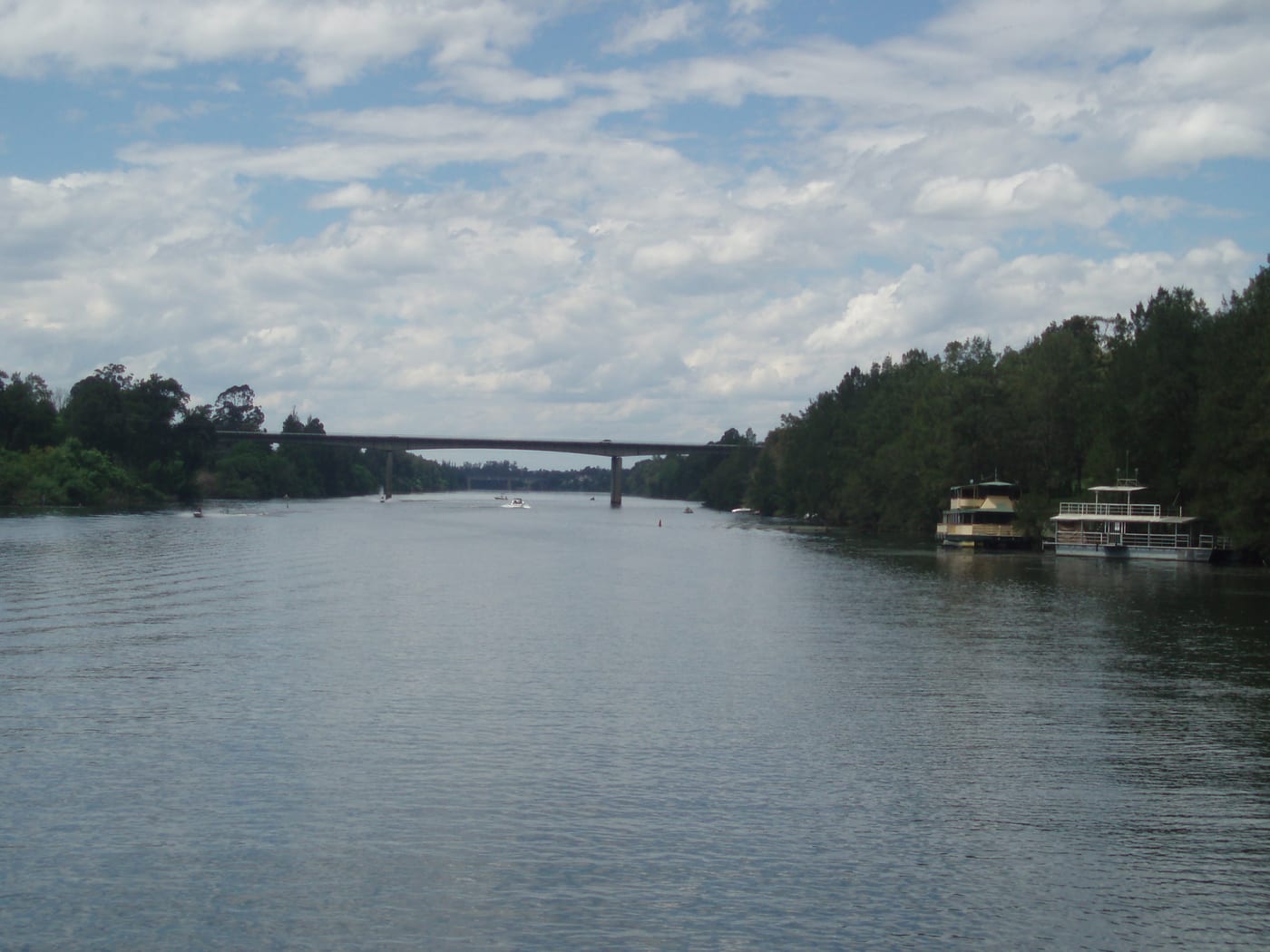
The Nepean River at the M4 crossing — a nearby landscape reference for Leonay's river and escarpment setting, not a photograph of a particular street.
Photo: sv1ambo / Wikimedia Commons ↗ · CC BY 2.0 ↗. Cropped for display.
Leonay map: use this to check the wider road, reserve and waterway pattern—not to approach a snake. Provider attribution appears inside the map.
Local habitat and snake activity Leonay
Leonay's river margin is a habitat cue for red-bellied black snakes, while wooded slopes, roof spaces and mature gardens can suit diamond pythons. Eastern brown snakes are also a wider western-Sydney possibility around open or disturbed ground. Never use the setting or colour as a field identification.
Red-bellied black snake
Often associated with wetter habitat such as creeks, drains, wetlands and dam margins.
Do not use this as an ID: The red or pink flank may be hidden from view, especially from above.
Australian Museum species guide ↗Diamond python
Can use mature trees, roof spaces, thick gardens, rockwork and sheltered structures.
Do not use this as an ID: Do not approach because a pattern appears familiar; large pythons can still defend themselves.
Australian Museum species guide ↗Eastern brown snake
May use open ground, grass margins, disturbed land and places where rodents are active.
Do not use this as an ID: Colour varies widely; a brown or grey snake cannot be identified safely by colour.
Australian Museum species guide ↗These are habitat-based possibilities for the wider district, not a claim that any species is common on a particular Leonay property. The Sydney snake identification guide explains the limits of visual identification.
Call 000 immediately. Keep the person still and calm, apply a pressure immobilisation bandage, and do not wash, cut or suck the bite. Follow the emergency operator and Healthdirect guidance ↗.
Common local questions
Answers for Leonay
Should I follow a snake from a Leonay yard towards the Nepean River?
No. Keep well back and do not enter the riparian reserve, riverbank vegetation or a neighbouring property. Note its direction and the last fixed landmark, then call from a safe place.
Do I need pest control or a snake catcher?
If you are searching for pest control or pest removal because you have found a snake, contact a licensed snake catcher directly. A pest-control business that does not provide licensed snake handling may need to refer your call, adding a step and potentially delaying arrangements. Some pest controllers also offer licensed snake catching; ask whether they can arrange an appropriately licensed handler. Keep people and pets away and call Snake Catcher Sydney Wide to confirm the fee, availability and estimated arrival.
Is the snake moved humanely?
The aim is safe capture and humane relocation in line with current NSW requirements. The snake should not be handled by an untrained person.
Can I make a Leonay property snake-proof?
No property can be made completely snake-proof. Keep retaining-wall gaps, pool equipment, timber stacks and under-deck storage visible and orderly. Check door sweeps and garage seals, trim only within the maintained yard and leave the Nepean riparian corridor undisturbed.
The local background comes from Penrith City Council — Nepean River riparian plan ↗, with snake safety checked against NSW Environment guidance ↗. The embedded public map is used to confirm the suburb, roads and named landscape reference. Habitat can vary from street to street, so we do not claim that a particular species is common at any address.